
Programme
Memory of a Free Festival: Launch Event
Memory of a Free Festival is a project conceived by Ormston House in response to the Carnsore Point anti-nuclear festivals that took place in Wexford between 1978 and 1981. Organised by a coalition of groups, the festivals were attended by thousands of people. These legions were unified by their shared opposition to what would have been the first nuclear power plant to be built in Ireland. In addition to musical entertainment and lectures the free festivals also included workshops and exhibitions. This touring project features contributions from contemporary artists and several individuals who were involved in organising the festival.
This afternoon event at Project is the first iteration of Memory of a Free Festival. The event begins with a chaired discussion between journalist Frank Connolly, performer Susie Kennedy and musician Christy Moore all of whom contributed to the festivals in various ways. This discussion concludes with a screening of original footage from the 1978 and 1979 festival filmed by Ken Lynam.
The second part of the event involves contributions from Orla Barry, Brian Duggan and Alanna O’Kelly. All of these are contributing to the touring exhibition at Ormston House, Wexford Arts Centre, and Uillin:West Cork Arts Centre. This event includes a sound screening of O’Kelly’s seminal artwork Chantdown Greenham Common. This event concludes with a performance by artist Michelle Doyle aka Rising Damp.
About the contributors:
Orla Barry is an artist and shepherd who lived in Brussels for sixteen years but now lives and works on the south coast of rural Wexford. Barry writes, makes video and sound installations, and creates performances. Her work focuses on language, both written and spoken, as well as its visual deconstruction and displacement, via frequently associative techniques. She explores means of communication and on how the complexity of human relationships is able to find a place for itself within this. Fiction, autoethnography, and oral history are blended to reflect on the culture of disconnection from the natural environment, the boundaries of art, and the rural everyday.
Frank Connolly is an investigative journalist and author based in Dublin and was one of the main organisers of the anti-nuclear festivals at Carnsore Point and other activities of the movement. Over his forty years in journalism, his investigations into political and police corruption in Ireland contributed to the establishment of two judicial inquiries. During his career, he has also reported extensively on the conflict and peace process in the North and on current affairs and politics for a range of publications and broadcast media. He has published several non-fiction books and a novel.
Rising Damp is the project of Dublin based visual artist and musician, Michelle Doyle. Originally a bass player in punk band Sissy, Doyle expanded her practice to include drum machines, synths and spoken word. Doyle works with film, sound, technology, and sculpture. She attended the National College of Art and Design where she received a Bachelor of Fine Art Media in 2013, and completed her Masters in Art and Research Collaboration in Dún Laoghaire Institute of Art, Design and Technology, Dublin in 2016.
Brian Duggan trained as a sculptor and now works in video and installation projects. His work seeks to investigate the physical limitations of the immediate environment on the individual. Stress and pressure, ideas of control and where we stand, how we are tied and what binds us, are all continuous references within his artistic practice. Duggan has long concerned himself with questions and difficulties within labour and leisure, history and tradition, politics and popular entertainment. His installations and film work are grounded in material history. A certain theatricality is implemented and, from time to time, results in humorous work that simultaneously makes statements about art, the overlooked individual, and society.
Susie Kennedy is an actor, jazz singer, drama teacher and humanist celebrant. Kennedy began working in theatre in Dublin in the 1970s and made a career of one-woman music revues. Kennedy performed in a play “DRINK THE MERCURY” at the first Carnsore Point festival in August 1978. She also performed in the ‘Anti-Nuclear Roadshow’ which, for two weeks later in 1978, toured across Ireland, North and South, connecting with local anti-nuclear groups.
Christy Moore is a singer and songwriter, born in Newbridge, Co. Kildare. An uncompromising political singer, Moore was centrally involved in organising the anti-nuclear festivals at Carnsore Point. He supported, and performed for, the H-Block hunger strikers and a range of other progressive campaigns and causes over many years. Now best known as a solo artist he was also a founding member of the bands Planxty and Moving Hearts.
Alanna O’Kelly attended the National College of Art and Design and the Slade School of Art, London. Her practice incorporates sculpture, performance, slide installation and film. Influenced by feminist politics, O’Kelly explores ideas of the psychic conflicts of our shared history and the continuity of tradition. O’Kelly went to Greenham Common in 1983 to take part in ‘Sounds Around the Base’ that had 30,000 to 50,000 women surrounding the 9-mile perimeter fence of the military base. Her work has featured in major group and solo exhibitions since the 1980s and she represented Ireland at the Sao Paulo Biennale in 1996.
This touring project is organised by Ormston House with funding from the Arts Council through the Touring of Work Scheme.
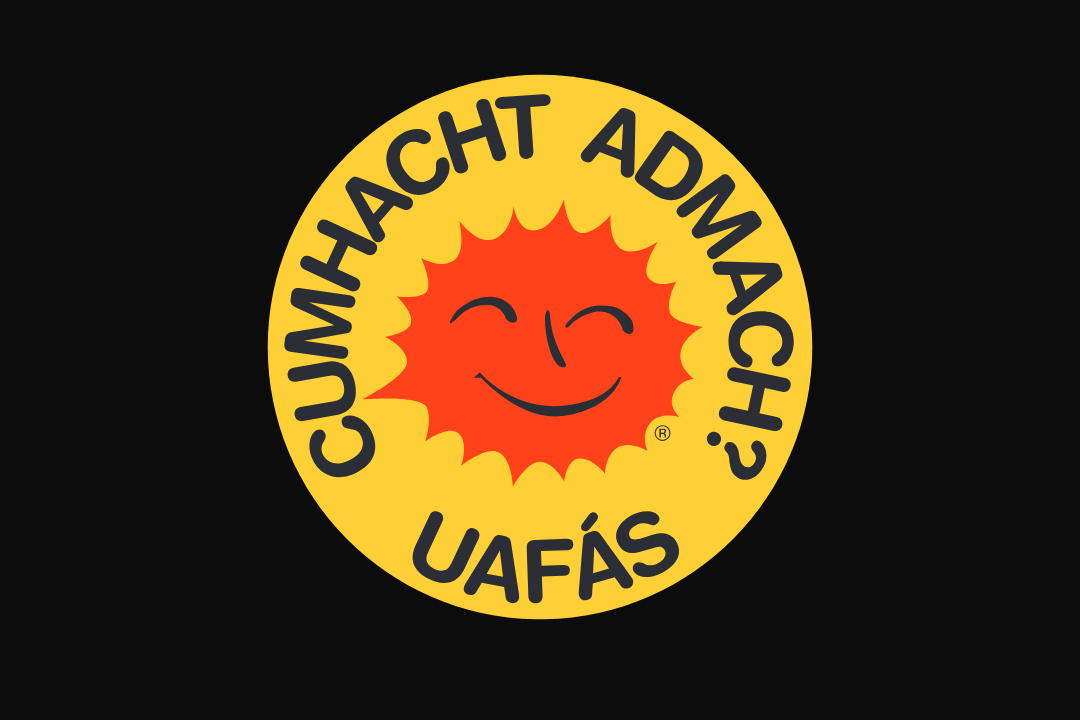
About the Smiling Sun logo:
The Smiling Sun logo was designed by 21-year-old Danish activist Anne Lund in 1975.
The logo features a smiling sun surrounded by the wording NUCLEAR POWER? NO THANKS – or the equivalent message in any other language – in yellow, red and black. The Irish language version of the logo was first produced in 1979, upon the request of the Irish Anti-Nuclear Movement.
A reproduction of the Smiling Sun in Irish will be presented as a billboard on the exterior of Project Arts Centre from early March.