
Programme
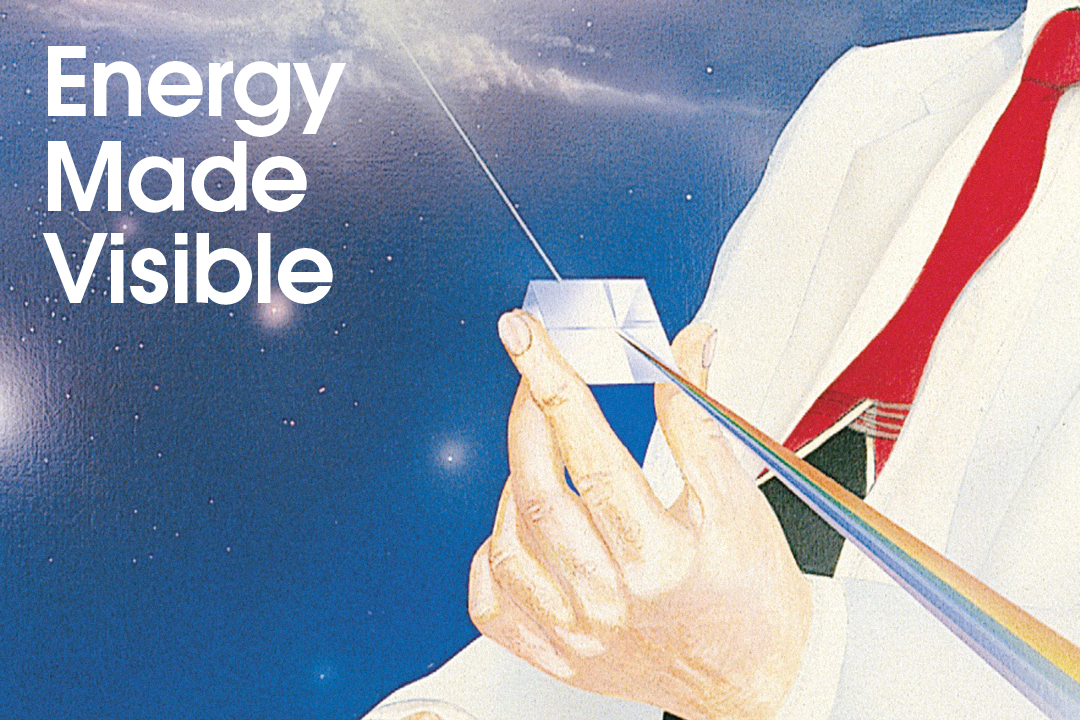
Energy Made Visible
Ormston House presents Energy Made Visible. The exhibition will open on Friday, 10 July from 7-9pm and will continue until 5 September 2026.
Energy Made Visible is a group exhibition centred around the paintings of Michael Ashur (1950–2024). Known for his meticulous airbrushed compositions, Ashur’s work is concerned with solar systems, celestial bodies, and overlaps between artistic and scientific disciplines. This exhibition at Ormston House, Limerick, places Ashur’s work in dialogue with four contemporary Irish artists. Contributions from Ann Maria Healy, Sean Lynch, Thaís Muniz, and Garrett Phelan activate and expand upon Ashur’s enigmatic paintings.
Born in 1950 and raised in Dublin, the artist (then known as Michael Byrne) commenced his studies at the National College of Art and Design in the late 1960s. Upon leaving NCAD, Byrne assumed the pseudonym Ashur, after a Babylonian sky god. The visual novelty of his work and its capacity to capture both eye and imagination were central to Ashur’s initial success.
Ashur’s early works show an awareness of international painting and he is one of the few Irish representatives of the shaped canvas movement. His paintings exemplify a tendency seen throughout the twentieth century, whereby artists embraced novel materials and technologies – in this case, acrylic paint and airbrush – to pioneer innovative vocabularies.
However, what makes Ashur distinctive in the context of Irish art history, are the non-art influences shaping his work. He came of age in the late 1960s, the era of the Space Race, which had a major impact on the collective consciousness. At the same time, sci-fi cinema and literature flourished and ideas gleaned from astrophysics permeated the popular imagination. Ashur drew heavily from such sources but his paintings also feature geometric forms and optical effects that evoke altered states of consciousness. Such imagery was propagated at that time via forms of mass art that were then circulating widely, such as poster art, magazines, and, of course, album sleeves. Ultimately, Ashur’s work represents the last gasps of a visual culture spawned by the psychedelic revolution. In his own words, his astral paintings reveal to us the ‘immutable laws of crystal formation at the centre of exploding stars’.¹
Many of the acquisitions of Ashur’s work in the 1970s and 1980s were by corporations with large, newly built premises. Organisations such as Telecom Éireann and RTÉ purchased monumental artworks to adorn their headquarters. Such was the ubiquity of his work that, for a time, it could have been described as campus or foyer art, cosmic décor for newly built cavernous environments. Yet although works by Ashur are held in collections across the state, they now mostly languish in storage units and basements. The upshot is that opportunities to view his work are now very few. Once considered cutting edge, even futuristic, Ashur’s paintings now appear anachronistic and cannot be neatly categorised.
When Ashur died in the spring of 2024, his work had not been included in any exhibitions for several decades. And so, Energy Made Visible represents the first time any of his artworks have been presented in unison since the 1990s. Included in this exhibition is a monumental shaped canvas entitled Galactic Probe (1972) and his Auto-Portrait with Prism (1982), which was originally commissioned for the National Self-Portrait Collection of Ireland.
These paintings form the key referent and backdrop for four contemporary artists whose inclusion accentuates certain aspects of Ashur’s paintings and illuminates aspects of his oeuvre. These artists reinvigorate and breathe life into the work of Ashur whilst drawing attention to the cyclical nature of aesthetics and the vicissitudes of art history.
With their luminous hues, subtly blended effects, and angular compositions, Ashur’s paintings are the natural counterpart to Ann Maria Healy’s animation entitled Gabhlán Gaoithe-Dara Sraith (Swift – Second Series). Ashur once described his works as ‘complex dramas, the plots of which vary from cosmic to molecular’² and the same can be said of Healy’s work. The landscape in this animation evokes the boundless vistas of Ashur’s paintings but is, in fact, the artist’s representation of the mechanics of the human brain. Healy’s depiction of neural pathways energised by thoughts (i.e., electrical and chemical signals) is essentially a demonstration of the ancient aphorism ‘as within, so without; as above, so below’.
Sean Lynch’s pamphlet features reproductions of archival material pertaining to Ashur in which the arc of his success can be mapped. Exhibition handouts, catalogues, clippings, and listings from the 1970s and ’80s offer glimpses into an Irish art world that has all but vanished. Lynch’s accompanying text considers how Ashur’s rise and fall is inextricably intertwined with the late twentieth-century dreams of a modernising Éire.
Thais Muníz’s sculptures are geometric diagrams forged in iron. Referring to the Yoruba cosmology, and the spiritual systems that stem from it, these objects are essentially sacred tools used to communicate with deities. While outer space has come to be regarded through the lens of science, it was traditionally viewed across all societies as the domain of the divine and referred to as ‘the heavens’. Muníz’s forms echo the hard-edged shapes seen in Ashur’s paintings but possess a ritualistic function.
For this exhibition Garrett Phelan has ‘translated’ a painting by Ashur (entitled Fragment of Orion) into sound. Using photo-synthesiser and image sonification technology Phelan has mapped the geography of this painting. The resulting recordings have been mixed, then pressed into a vinyl record. A one-off radio broadcast of this record will take place during the exhibition, functioning as a sonic monument to the late artist.
Special Closing Event on 5 September:
The celestial and scientific qualities of Ashur’s work resonate distinctly, both aesthetically and chronologically, with developments in electronic music, particularly the Berlin School of the 1970s. Jürgen Simpson and Neil O’Connor will respond to this exhibition with a live performance that explores the timbral and rhythmic qualities of that era, using custom sequencing systems and modular synthesis.
¹From text by Michael Ashur, written to accompany an exhibition at the Riverrun Gallery, Honan’s Quay, Limerick, October 1988.
²Ibid.
Energy Made Visible will run from July to September and is supported by the University of Limerick, Kildare County Council, and the Estate of Michael Ashur.
Ormston House is supported by the Arts Council of Ireland and Limerick Arts Office.

Information
A Plain English version of this text is available here.Exhibition opening: Friday, 10 July from 7-9pm. Exhibition dates: 11 July – 5 September 2026.
Michael Ashur, Auto-Portrait with Prism, (detail) 1982. Image courtesy of the University of Limerick and The Estate of Michael Ashur.
Design by Ian Malone.
Ormston House would like to thank technical expert Chris Boland.