
Programme
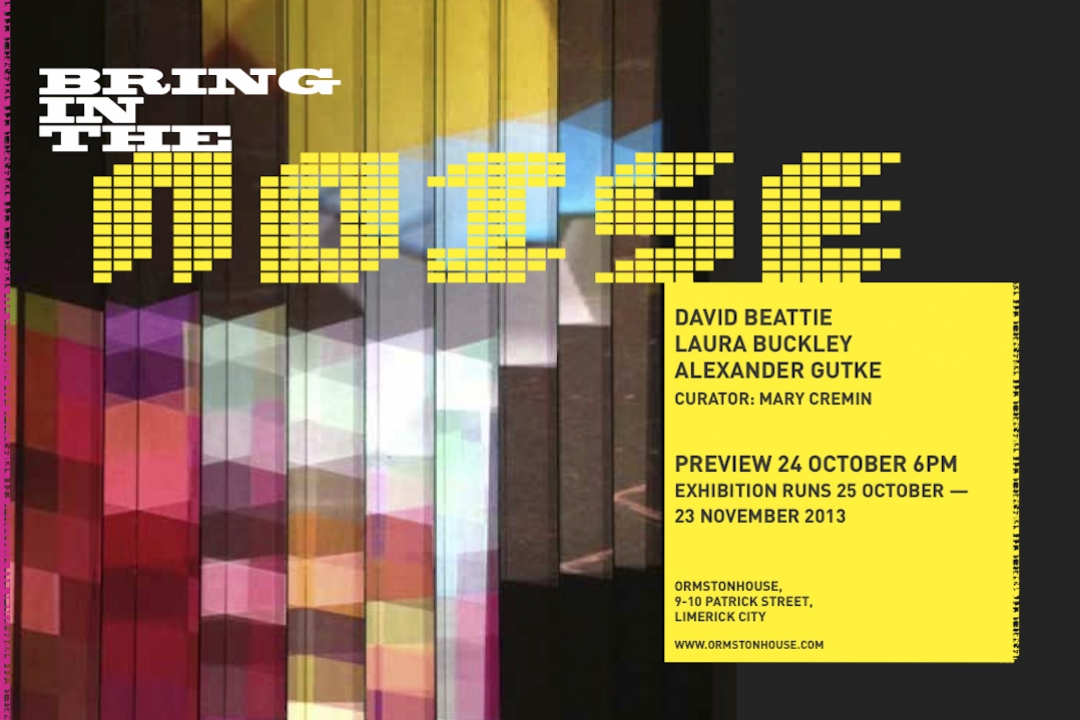
Bring in the Noise
Bring in the noise focuses on artists whose practices engage with and appropriate technology, creating assemblages and installations. The works appeal to our natural desire to understand what surrounds us through visuals, sound and objects. The sound elements of these diverse works interact with each other, creating a soundscape that is both playful and particular to each of the works. While each artist’s approach to sound varies- from inaudible, to computer generated to analog, the diversity of these sounds consider how we listen. In a time where we have become increasingly isolated in how we interact in public spaces, often plugged into our self-styled soundtrack, we can sometimes block out the sounds of the everyday. This exhibition creates a shared space through active listening; the communal aural experience connects the listeners through immersive sounds in addition to a strong visual and sculptural component.
David Beattie’s pieces Auto-rock (2013) and Erratic (2013) combines his interest in low fidelity sound and organic movements. The rock, an inanimate object, becomes a means to interrupt and determine the sound of the rotating record. A three hundred and sixty degree documentation of a rock in the landscape, Erratic reflects on movement and the elemental within the landscape. This is echoed in the rotation of the record player in Auto-rock and the repetitious voice that punctuates its movement. The piece Between 12.8hz (2011) is a sculptural work that emits a sound that is inaudible to the human ear. These works highlights Beattie’s preoccupation with intermediary moments where physics, philosophy, technology and nature collide. The low-fi nature of his works and the simplicity with which these objects are presented create a dynamic interplay between the object and it becoming something other.
Laura Buckley’s, ZigZag (The Magic Know-How) (2013) is a projection of a visual landscape documenting the everyday objects that she comes into contact with, both inside and outside of the studio. Buckley manipulates footage creating a texture and colour that are both saturated and visually arresting. She creates a dialogue between a variety of visual and aural techniques such as the mirrored structure, which allows for the images to expand and contract; the splicing of static and moving images and the ambient sound of the work creates a rhythm that accentuates the movement within the piece.
Alexander Gutke’s 1-2-3-4 (2010) is a video work that plays with notions of sculpture and performance. The image of the lone snare drum combined with the cacophony of falling drumsticks focuses on illusionism, performance and the cinematic. Gutke is interested in the mechanics of the camera, film and slide projectors and often uses these as tools to create a poetic, minimalist deconstruction of the apparatuses. In 1-2-3-4 he engages in visual and aural trickery not to deconstruct the mechanics but to create an almost mystical performance without human intervention.
It is a sense of illusion that pervades these works and connects these artists. Appropriating everyday objects and reanimating them in alternative contexts, the artists play with the viewer’s perception; through both the visual and the aural, thus creating something far removed from the individual components – a poetic and romantic world, albeit an imagined one.
Special thanks to Helen Carey & Siobhán O’Reilly at Limerick City Gallery of Art; Matt Gidney at Limerick School of Art & Design; SITE Gallery Sheffield and Andy Spence of NYPC for sound collaboration on ZigZag (The Magic Know-How).
Admission is free and all are welcome.

